Coffee Grind Size Chart: The Right Grind for Every Brew Method
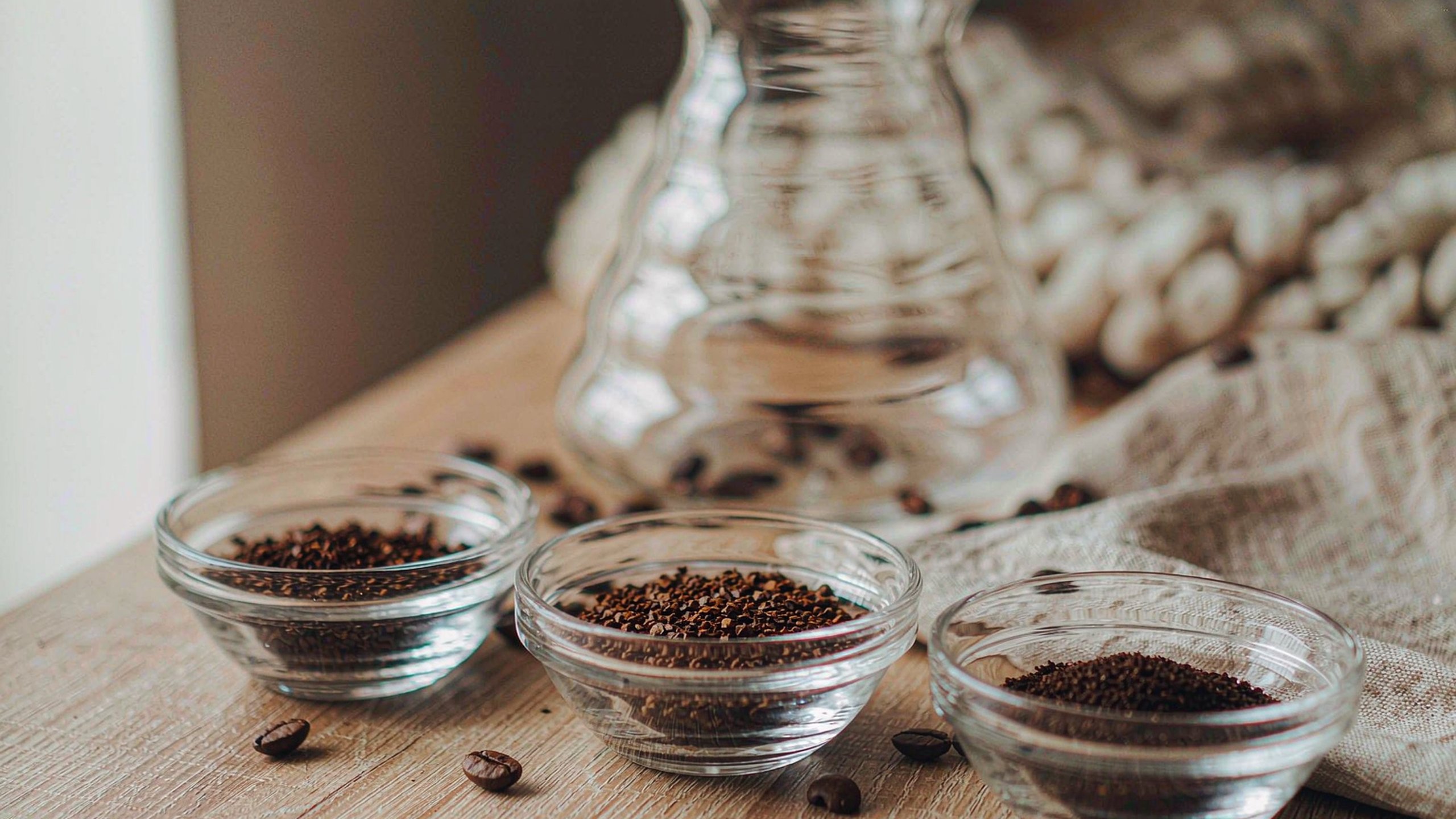
Grind size is the fastest lever you have on the taste of a cup, and it is the one most home brewers never touch. Espresso needs a fine grind around 200–380 microns; moka pot and cone pour over sit in the middle at roughly 400–700; drip machines want a medium grind near 500–800; French press and cold brew go coarse, from about 800 all the way to 1,400 microns. If a cup tastes sour or thin, go finer. If it tastes bitter or drying, go coarser.
This guide gives you the full grind size chart by brew method, the particle ranges behind each one, and the one-variable test that fixes a bad cup in a single brew.
Why Grind Size Changes the Cup More Than Anything Else
Brewing is extraction, and extraction runs on surface area. A coarse particle exposes a small amount of its surface to water; a fine particle exposes a great deal more. Because the same weight of coffee is being brewed either way, grinding finer means water reaches far more of the coffee in the same amount of time.
Time is the other half of the equation. An espresso shot is over in about 25 to 30 seconds, so the grind has to be fine to extract enough in that window. A French press runs for four minutes and a cold brew for twelve hours or more, so the grind has to be coarse or the water keeps pulling past the point where the cup tastes good.
The failure modes are symmetrical and easy to recognise. Grind too coarse for the method and the water runs through before it has taken enough with it: the cup tastes sour, sharp, thin and hollow. Grind too fine and extraction overshoots into the harsh compounds: the cup tastes bitter, drying and astringent, and in an immersion brewer it also turns gritty and muddy because the mesh lets the fine particles through.
The Complete Coffee Grind Size Chart
Particle sizes overlap between methods, and every published chart draws the boundaries a little differently, so treat the ranges as starting points rather than rules. What matters is the order, and the texture you can actually recognise in your hand.
| Brew method | Grind | Particle size | Feels like | Typical brew time |
|---|---|---|---|---|
| Turkish / ibrik | Extra fine | 40–200 µm | Flour, icing sugar | 3–5 min |
| Espresso | Fine | 200–380 µm | Powdered sugar | 25–30 sec |
| Moka pot | Fine to medium-fine | 360–660 µm | Table salt | 4–6 min |
| Cone pour over | Medium-fine | 400–700 µm | Granulated sugar | 2:30–3:30 |
| Flat-bed pour over | Medium | 500–800 µm | Coarse sand | 3–4 min |
| Drip machine | Medium | 500–800 µm | Sand | Varies |
| Immersion press | Coarse | 800–1,200 µm | Coarse sea salt | 4 min |
| Cold brew | Extra coarse | 900–1,400 µm | Breadcrumbs, peppercorns | 12–18 hr |
| Percolator | Coarse | 1,400–1,800 µm | Coarse breadcrumbs | Varies |
Read the table as a single line from fine to coarse and the logic is obvious: the shorter the contact time, the finer the grind. Pressure shortens contact time dramatically, which is why espresso sits at the fine end while cold brew, with the longest contact time of all, sits at the very coarse end.
How to Tell Grind Size by Feel, Without a Reference Chart
Micron numbers are for dialling in a grinder you already own. For everything else, texture is the useful measure.
- Extra fine — rub it between your fingers and it disappears into the ridges like flour. Nothing gritty survives.
- Fine — feels like powdered sugar: soft, slightly clumping, with almost no distinct grains.
- Medium-fine — like granulated sugar. You can feel individual grains, but they are small and uniform.
- Medium — like dry sand. It pours freely and leaves a slight dust on your palm.
- Coarse — like coarse sea salt. Distinct, crunchy particles that you can pick out one at a time.
- Extra coarse — like broken peppercorns or rough breadcrumbs, with visible irregular chunks.
One warning about the texture test: it only works if your grinder produces an even particle size to begin with. A blade grinder smashes beans into a mix of powder and chunks in the same batch, and that unevenness is a bigger flavour problem than the nominal setting. A burr grinder is what makes any grind chart meaningful.
Grind Size for Espresso: Fine and Consistent
Espresso is the least forgiving method on the chart and the only one where small changes produce obvious results. The grind has to be fine enough to build resistance against roughly nine bars of pressure, but not so fine that the puck packs solid and water carves a channel through the path of least resistance. When that happens you get a sour, thin shot from one part of the puck and a bitter one from another in the same pour.
Dial espresso in by time rather than taste. Aim for a shot that runs 25 to 30 seconds from pump start to the target yield: running fast means the grind is too coarse, stalling means it is too fine. Change one notch, pull another shot, and keep the dose and yield fixed while you do it. Our espresso cup size guide covers the other variable — the cup you pull the shot into changes how it tastes.
Because the volume is small, the cup matters more here than anywhere else. A small double-wall glass shows the crema layer and holds the heat of a 1oz pour, which a wide ceramic cup simply cannot do.

6.7oz Double Wall Espresso Cups (Set of 2)
A 6.7oz double-wall glass is sized for a double shot: the insulating air gap holds the heat of a small pour and the clear body lets you see the crema separate from the body of the shot.
Buy Now
17oz Double Walled Glass Mug
17oz of double-wall glass suits drip, pour over and immersion brews, where a medium grind and a three to four-minute contact time produce a far larger cup than espresso does.
Buy Now
17oz Double Walled Glass Mugs (Set of 2)
If you dial in shots for two, a matched pair keeps the comparison honest — same glass, same wall thickness, same heat retention on both sides.
Buy NowGrind Size for Pour Over and Drip
Filter brewing is the middle of the chart and the most forgiving place to learn. A cone pour over wants a medium-fine grind, around 400–700 microns, that lets water draw down in two and a half to three and a half minutes. A flat-bed brewer or an automatic drip machine wants something slightly coarser, in the region of 500–800 microns.
Drawdown time is your readout. If the bed drains much faster than three minutes and the cup tastes thin, the grind is too coarse. If it stalls and the brew takes five minutes or more, the grind is too fine and the cup will taste dry and bitter. Our pour over guide covers the technique, and the coffee-to-water ratio guide covers the dose that goes with it.
Grind Size for French Press and Cold Brew
Immersion methods sit at the coarse end because the coffee stays in contact with the water for minutes or hours rather than seconds. A French press wants a coarse grind, roughly 800–1,200 microns, like coarse sea salt. Go finer and two things go wrong at once: the cup over-extracts into bitterness, and the metal mesh lets a cloud of fine particles into the glass, leaving grit at the bottom and a muddy, heavy texture.
Cold brew is the coarsest of all, around 900–1,400 microns — the coarsest setting on most home grinders. With a twelve to eighteen hour steep there is more than enough time to extract everything, and a finer grind simply over-extracts into a harsh, woody concentrate. Our cold brew concentrate guide covers the ratio and the dilution.
Fix a Sour or Bitter Cup by Moving the Grind One Step
Taste is the final arbiter, and it points in a reliable direction. Work through this order, changing one thing at a time so you know what caused the difference.
| What the cup tastes like | Likely cause | What to change |
|---|---|---|
| Sour, sharp, hollow | Under-extracted | Grind one step finer; keep dose and water the same |
| Weak, flat, watery | Under-extracted or too dilute | Check the dose first, then grind finer if it is also sharp |
| Bitter, harsh, drying | Over-extracted | Grind one step coarser |
| Muddy, silty, gritty | Too many fine particles | Grind coarser and pour more gently |
| Balanced but too light | Strength, not extraction | Leave the grind alone; use more coffee |
| Balanced but too heavy | Strength, not extraction | Leave the grind alone; use less coffee or dilute |
The most common mistake is trying to fix a weak cup by steeping it longer. That adds dryness before it adds body, because the compounds that arrive late are the astringent ones. Fix the grind and the dose first, and reach for time last.
Why Your Grinder's Numbers Do Not Transfer
A setting of 5 on one grinder does not produce the same particle size as a setting of 5 on another, and the same grinder drifts as its burrs wear in. Published click counts and dial positions are therefore not portable. What does transfer is appearance, feel and the taste of the cup.
The practical approach is to find the setting that makes your usual method behave correctly — a pour over that drains in three minutes, a French press that tastes sweet rather than drying — and write that number down next to the coffee and the recipe. From there the chart above is only a starting point: adjust one notch, taste, and record what you changed.
Frequently Asked Questions
What grind size should I use for pour over?
Medium-fine, around 400–700 microns, roughly the texture of granulated sugar. If the brew drains in much less than three minutes and tastes thin, grind finer; if it stalls and tastes dry, grind coarser.
What grind size is best for a French press?
Coarse, around 800–1,200 microns — like coarse sea salt. A finer grind over-extracts during the four-minute steep and also sends sediment through the mesh into the cup.
Do I need a burr grinder for a grind size chart to be useful?
Practically, yes. A blade grinder produces a mix of powder and chunks in the same batch, so the average particle size is meaningless. A burr grinder gives a consistent particle size, which is what makes the ranges in any chart reproducible.
Should I grind finer for light roasts?
Usually, one step. Light roasts are denser and release flavour more slowly, so they often need a slightly finer grind or a slightly longer brew to reach the same extraction as a dark roast.
Why does my espresso taste sour no matter what I do?
If the shot also runs fast — under about 20 seconds — the grind is almost certainly too coarse. Grind finer and pull another shot, keeping the dose and yield fixed, until the shot time lands in the 25–30 second window.
Final Thoughts
Grind size is the cheapest upgrade in coffee. It costs nothing, it takes seconds to change, and it moves the cup further than any accessory you can buy. Match the grind to the contact time of your method, calibrate your fingers against the texture descriptions above, and fix a bad cup by moving one notch rather than by changing three things at once.
And because the whole loop runs on what you can see and taste, clear glass earns its place at the bench: watching the bed drain and the crema settle turns guesswork into feedback.
As an Amazon Associate, MESNEY earns from qualifying purchases. Prices and availability are subject to change.